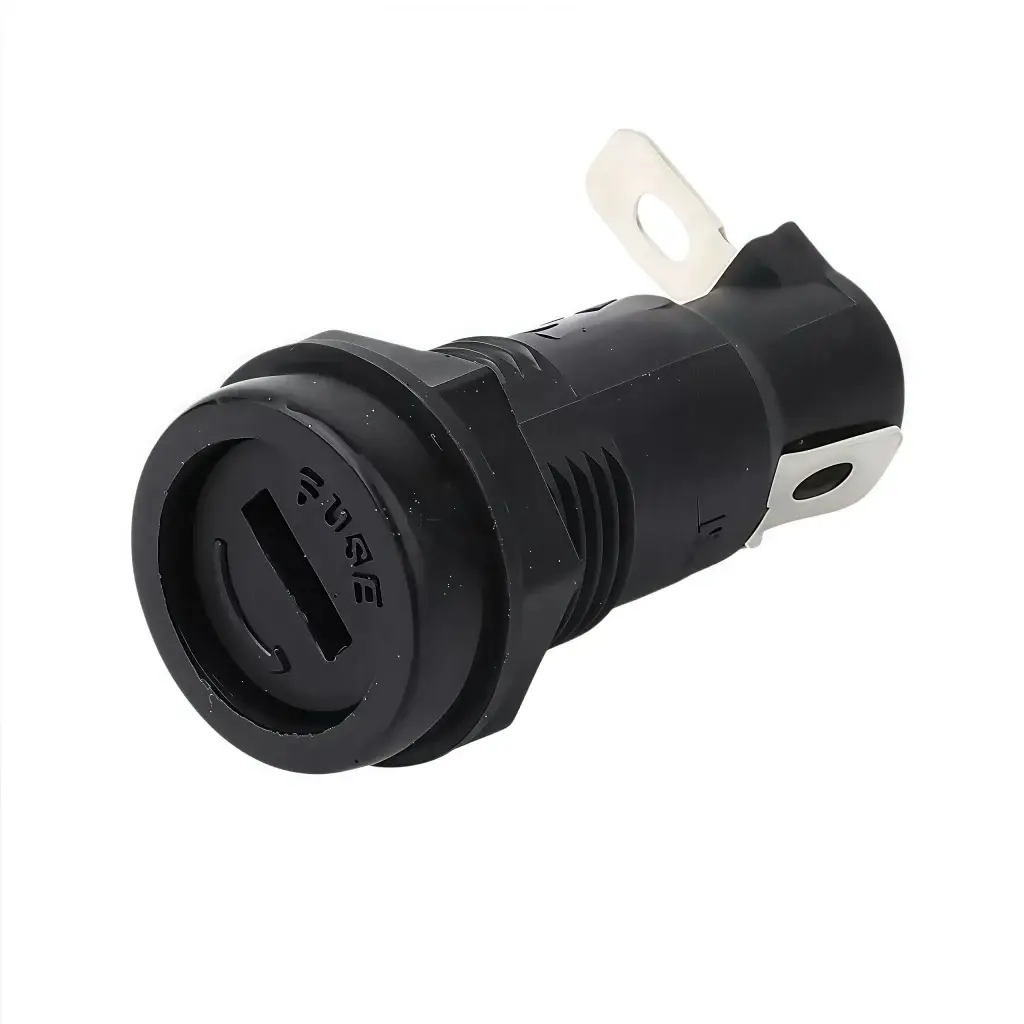













Panel mount fuse holder for 5x20mm cartridge fuses is compact panel‑installed over‑current‑protection component for low‑voltage electrical systems. This fuse holder adopts high‑strength PBT insulating housing together with 0.5mm thick phosphor‑bronze conductive terminals, offering robust insulation, stable contact and reliable over‑current protection for both AC and DC circuits. The threaded‑nut panel‑mount design supports quick front‑side fuse replacement without opening the equipment enclosure, widely adopted in industrial control cabinets, switching power supplies, household appliances and instrumentation front panels.
Core Product Features
- Compatible with standard 5×20mm glass / ceramic cartridge fuses, mainstream specification for low‑voltage small‑power protection
- Rated 10A at 250V / 125V AC/DC; 50A breaking capacity for effective fault‑current interruption
- PBT (polybutylene terephthalate) housing, UL94 V0 flame‑retardant grade; excellent heat‑resistance, arc‑suppression and dielectric performance
- 0.5mm thick phosphor bronze terminals, good spring tension, stable clamping force, contact resistance below 5 mΩ
- 3000V AC power‑frequency withstand voltage; insulation resistance >100 MΩ for high‑safety operation
- Threaded‑nut panel‑mount structure, standard panel cut‑out dimension; easy front‑panel fuse servicing
- RoHS‑compliant, satisfies global electronics environmental‑protection and safety standards
Compared with PCB‑mount fuse clips, this panel‑mount variant enables convenient front‑panel fuse replacement during maintenance. PBT material brings outstanding thermal stability, making it a preferred solution for power adapters, bench‑top instruments and general‑purpose low‑voltage control circuits.
Full Technical Specifications
| Specification Item | Parameter Value |
|---|---|
| Model | OP520 |
| Compatible Fuse | 5 × 20 mm glass & ceramic cartridge fuse |
| Rated Current | 10A |
| Rated Voltage | 250V / 125V AC / DC |
| Breaking Capacity | 50A |
| Power Frequency Withstand Voltage | 3000V AC |
| Housing Material | PBT, UL94 V0 flame‑retardant |
| Terminal Material | 0.5 mm thick phosphor bronze |
| Contact Resistance | < 5 mΩ |
| Insulation Resistance | > 100 MΩ |
| Mounting Method | Panel mount, threaded nut fixing |
Selection & Application Guidance
When selecting this 5×20 mm panel mount fuse holder, confirm fuse dimension, system voltage type (AC/DC), and continuous operating current first. Choose matching‑rating 5×20 glass/ceramic cartridge fuses and keep a 1.25‑1.5× safety margin against continuous‑load overheating. For projects requiring front‑panel fuse change‑out, this threaded‑nut panel‑mount variant reduces maintenance work without opening equipment housing. Prefer UL94 V0 PBT‑housing parts for high‑temperature or arc‑risk environments. Verify panel cut‑out dimension matches drawing specifications for secure mounting and stable electrical contact.
Typical Application Scenarios
- Industrial control cabinets and small‑automation‑equipment circuits
- Switching power supplies, power adapters and power‑distribution units
- Test instruments, multimeters and laboratory bench power‑supply circuits
- Household appliances and small‑power commercial electrical equipment
- Communication equipment and network‑device power‑input protection
- LED power drivers and low‑voltage small‑power modules
- Medical auxiliary equipment and low‑voltage control‑system circuits
Installation & Maintenance Instructions
1. Select correct‑rating 5×20 mm glass / ceramic cartridge fuse per your circuit‑protection requirements.
2. Drill standard mounting hole on equipment panel; insert fuse holder from front face, fasten rear fixing nut to achieve firm installation.
3. Secure wiring to rear terminals properly and add necessary insulation protection to prevent short‑circuit hazards.
4. Insert cartridge fuse fully and tighten cap to guarantee reliable contact and insulation performance.
5. Do not operate beyond published rated voltage‑current limits to avoid insulation breakdown and safety risks.
6. Cut off full power supply before fuse replacement to prevent electric shock and accidental short‑circuit damage.
7. Periodically inspect terminals and fuses for looseness, oxidation or thermal overheating signs; replace components in time when anomalies are found.
Frequently Asked Questions
Q1: Which fuse sizes does this panel mount fuse holder accept?
A1: It accepts standard 5×20 mm glass and ceramic cartridge fuses, the most widely‑used small‑size specification for low‑voltage equipment circuit‑protection.
Q2: What are its rated current and voltage ratings?
A2: Rated current is 10A; rated voltage 250V /125V for both AC and DC, suitable for most small‑power electrical‑equipment‑protection scenarios.
Q3: What material is the housing made of?
A3: Housing uses PBT engineering plastic with UL94 V0 flame‑retardant grade, featuring good heat‑resistance, arc‑suppression and insulation‑performance.
Q4: What about insulation‑related electrical‑performance?
A4: 3000V AC power‑frequency withstand voltage; insulation resistance >100 MΩ to ensure safe low‑voltage‑circuit‑operation.
Q5: What are the terminals specifications?
A5: Terminals are constructed from 0.5 mm‑thick phosphor bronze; contact resistance is less than 5 mΩ with stable spring clamping force.
Q6: What mounting style does it adopt?
A6: Threaded‑nut panel‑mount design. Install from equipment front‑panel and fasten nut from rear side for stable installation and convenient fuse‑replacement maintenance.
Q7: What are main application‑fields?
A7: Applied for industrial‑control cabinets, switching power‑supplies, test instruments, household appliances, communication‑equipment and various small‑power AC‑DC over‑current‑protection circuits.