
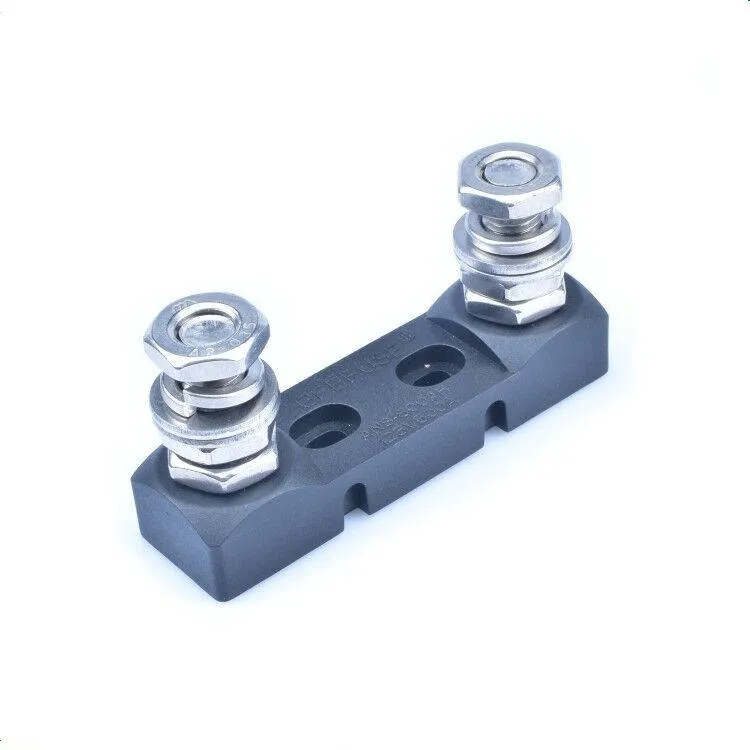
Description
- GFEV/A800AF Product Dimension Diagram:
- GFEV/A800AH Product Dimension Diagram:
- Product Specifications:
- Voltage: 12V-125V (DC)
- Current: 30A-500A (DC)
- Base insulation: DIN7708/1
- Operating temperature: -40 degrees to 125 degrees
- Matching Fuse: GFEFUSE (ANL-A series) fuse (30A-500A)
- Applications: The product is practical for automotive batteries and power supplies, mobile power base stations, new energy vehicle buses.

FQA
1.What is a bolt fuse holder?
A bolt fuse holder is a mounting base designed for bolt-type fuses. It fixes fuses and wiring via bolts to realize circuit conductive connection and insulation protection, mostly used in high-current and high-power circuit scenarios.
2.What are the main functions of a bolt fuse holder?
Fix bolt-type fuses, ensure smooth circuit conduction, provide insulation safety protection, facilitate fuse installation, replacement and later maintenance, and adapt to the stable operation of high-current circuits.
3.What scenarios are bolt fuse holders suitable for?
Widely used in high-current circuit protection fields such as new energy charging piles, photovoltaic inverters, energy storage equipment, new energy vehicles, industrial power supplies, UPS power supplies, motor control cabinets, and power distribution equipment.
4.What is the difference between bolt fuse holders and ordinary fuse holders?
It is fastened by bolts, suitable for high current and high voltage, with firmer connection and less heating and loosening; ordinary fuse holders are mostly plug-in type, suitable for low-current and low-voltage circuits, with weaker stability than bolt type.
5.What core parameters should be paid attention to when selecting a bolt fuse holder?
Pay attention to rated current, rated voltage, thread specification, poles (1P/2P/3P), installation size, flame retardant grade, operating temperature, compatible fuse model and material conductivity.
6.What materials are bolt fuse holders made of?
The insulating shell is made of flame-retardant PA, bakelite, glass fiber reinforced engineering plastics, which is high temperature resistant and non-flammable; conductive parts are made of brass/red copper, with high conductivity and low temperature rise, ensuring stable circuit transmission.
7.What are the precautions for installing a bolt fuse holder?
Tighten bolts moderately to prevent slipping or loosening; compress wiring terminals to avoid heating due to poor contact; match fuses of the same specification, and it is strictly forbidden to mix models with different currents and voltages; keep the installation environment dry and ventilated.
8.Common faults and solutions of bolt fuse holders?
1: Loose bolts and heating, Solution: Retighten bolts;
2: Poor contact and blowing, Solution: Clean wiring terminals and replace compatible fuses;
3: Insulation aging, Solution: Replace with a new fuse holder.
9.Do bolt fuse holders support customized services?
Customization is supported, including thread specification, rated current and voltage, poles, installation holes, outlet mode and appearance color. Cross-border safety certifications such as UL, CE and CCC can be handled as required.
10.What is the service life of a bolt fuse holder?
Under normal dry and ventilated environment, with standardized installation and use, the service life can reach 5-10 years; if it is in harsh environments such as high temperature, humidity and dust, regularly check the component status and replace aging parts in time.