
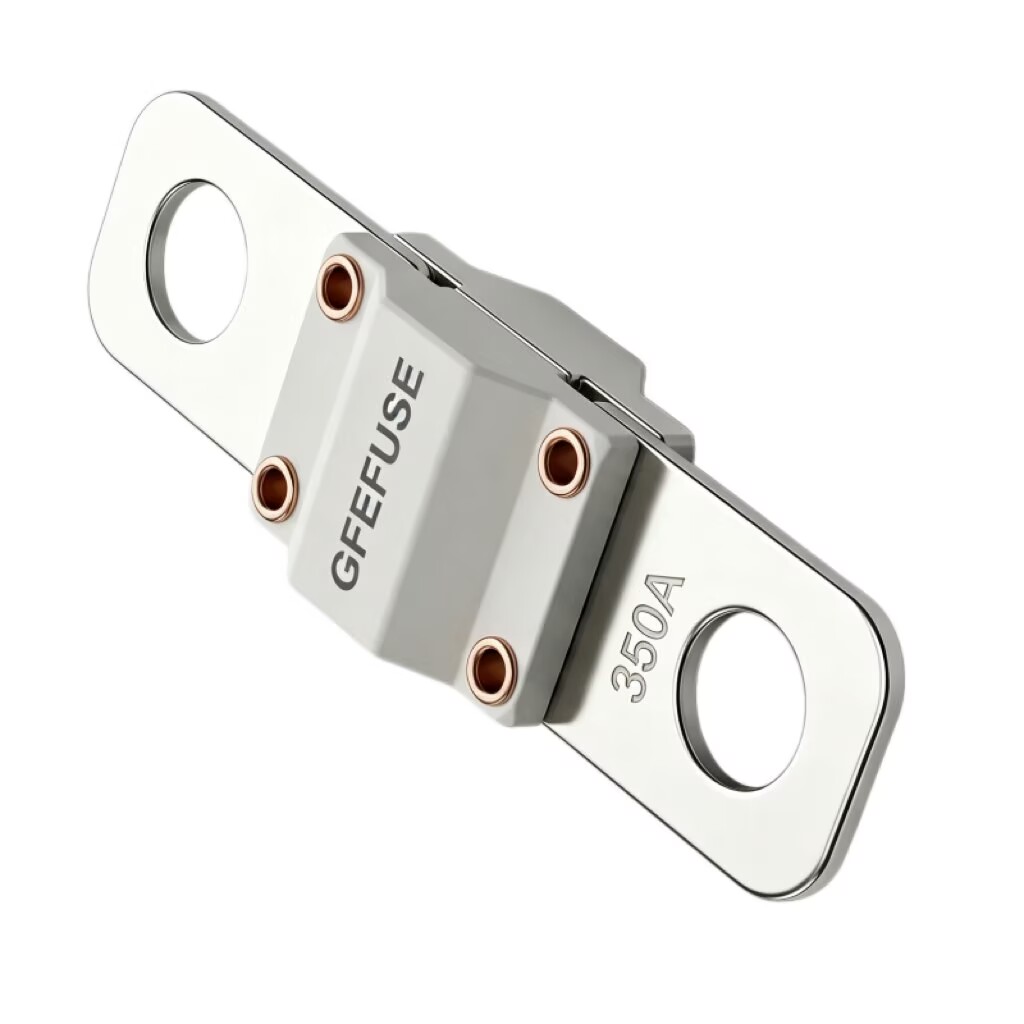
Description
ANL/C125SF35 50A-350A 125V Energy storage fuse
1.Dimensions- mm

2.Product Features
- Mild Hybrid Vehicles
- Vehicle Power Distribution (Electric Vehicles, Electric Motorcycles)
- Material Handling Systems
- All Supercapacitors and Battery Systems
- High Current Line Protection
- Compact Design for High Current Applications
- Rated Voltage: Below 125Vdc
- Plastic Housing (PBT, PPS,Ceramics), Screw-on Terminal Design
- Compliant with: UL248 Standard
- Operating Temperature: -40 to 125℃degrees
3.Electrical Characteristics
| % of Rating | Opening Time Min / Max |
| 50A – 350A | |
| 100 | 4H / ∞ |
| 300 | ~/10S |
4.Product specifications
| Part Number | Rated current (A) | Voltage Rating
(v) |
Melting I²t(Pre-arcing)
A²s |
Arcing I²t A²s | Clearing I²t(Total)
A²s |
| ANL-C125050SF35 | 50A | 48V
63V 80V 125V
|
250 | 150 | 400 |
| ANL-C125060SF35 | 60A | 360 | 216 | 576 | |
| ANL-C125080SF35 | 80A | 640 | 384 | 1024 | |
| ANL-C125100SF35 | 100A | 1250 | 750 | 2000 | |
| ANL-C125150SF35 | 150A | 2230 | 1338 | 3568 | |
| ANL-C125200SF35 | 200A | 5400 | 3240 | 8640 | |
| ANL-C125250SF35 | 250A | 9600 | 5760 | 15360 | |
| ANL-C125300SF35 | 300A | 21800 | 13080 | 34880 | |
| ANL-C125350SF35 | 350A | 38500 | 23100 | 61600 |
Note: Different currents and standards can be customized according to customer requirements
Test Condition: 10× rated current, DC 125V, 25℃ ambient temperature, tolerance ±10%
Product Model: ANL/C125SF35 Energy Storage Fuse
- Model Number: ANL/C125SF35
- Current Range: 50A ~ 350A
- Rated Voltage: 125V DC
- Application: Energy storage system, lithium battery pack, solar energy storage, off-grid power supply, battery energy storage cabinet
- Product Type: ANL type high-current energy storage fuse
- Core Advantage: Overcurrent protection, short-circuit protection, high breaking capacity, low temperature rise, stable performance for energy storage equipment
ANL/C125SF35 50A-350A 125V Energy Storage Fuse
- Model: ANL/C125SF35
- Rated Current: 50A ~ 350A (50amp, 100amp, 150amp, 200amp, 250amp, 300amp, 350amp optional)
- Rated Voltage: 125V DC
- Usage Scenario: Energy storage battery system, solar storage, household energy storage, industrial energy storage cabinet
- Function: Short circuit & overcurrent protection for energy storage equipment
ANL/C125SF35 50A-350A 125V energy storage fuse, ANL C125SF35 energy storage fuse, 125V ANL high current fuse 50A to 350A, lithium battery energy storage ANL fuse C125SF35
1. Executive Summary
2. Product Overview & Design Principle
1 Design Background
- Realize rapid arc extinction under 125V DC high fault current;
- Resist thermal fatigue caused by long-term charge-discharge cycling;
- Maintain low contact resistance to reduce system power loss;
- Comply with universal ANL bolt-on installation standard for easy compatibility with existing fuse bases.
2 Structural Composition
- Fuse Element: Silver-plated copper alloy, precisely processed with multi-section constricted structure. Ensures accurate fusing characteristic and low temperature rise under rated current.
- Arc-extinguishing Medium: High-purity quartz sand with graded particle size, densely filled inside the housing. Quickly absorbs arc energy and cools conductive plasma to cut off fault arc.
- Insulating Housing: High-temperature resistant flame-retardant thermoplastic, excellent mechanical strength and insulation performance, anti-cracking under sudden temperature change.
- Conductive Terminal: Tin-plated brass terminal block, anti-oxidation and anti-corrosion, guarantees stable connection performance under high current.
3. Complete Technical Specifications
3.1 Basic Electrical Ratings
| Item | Parameter |
|---|---|
| Model Series | ANL/C125SF35 |
| Nominal Rated Voltage | 125V DC |
| Rated Current Range | 50A, 60A, 80A, 100A, 125A, 150A, 200A, 250A, 300A, 350A |
| Rated Breaking Capacity | 6 kA DC (at 125V DC) |
| Pre-arcing Time (Short Circuit) | ≤ 10 ms |
| Total Clearing Time | ≤ 20 ms |
| Typical I²t Value | Low energy let-through, compatible with semiconductor and lithium battery protection |
| Power Frequency Withstand Voltage | 500V AC / 1min, no breakdown |
3.2 Mechanical & Physical Parameters
- Mounting Type: ANL standard bolt-on installation
- Overall Dimension: 82 mm × 20 mm × 8.5 mm
- Recommended Bolt Torque: 8 ~ 10 N·m
- Weight: 45 ± 3 g (per piece)
3.3 Environmental Adaptability
- Operating Ambient Temperature: -40 ℃ ~ +85 ℃
- Storage Temperature: -50 ℃ ~ +90 ℃
- Maximum Operating Altitude: 5000 m
- Current Derating Rule: For altitude above 2000 m or ambient temperature above 60 ℃, derate rated current by 10% per 10 ℃ temperature rise.
- Vibration Resistance: Compliant with IEC 60068-2-6, suitable for mobile equipment such as electric vehicles and engineering vehicles.
3.4 Compliance & Certification
- Execution Standards: UL 248,
- Environmental Compliance: RoHS 2.0, REACH
- Flame Retardant Grade: UL94 V0
3.5 Contact Resistance & Temperature Rise
- Initial Contact Resistance: ≤ 15 μΩ
- Temperature Rise: Under 100% rated current, steady-state temperature rise ≤ 40 K (ambient 25 ℃)
4. Core Performance Advantages
4.1 Superior DC Arc Extinguishing Performance
4.2 Excellent Thermal Cycling Durability
4.3 Low Power Loss & High System Efficiency
4.4 Universal Compatibility & Easy Installation
4.5 High Safety & Reliability
5. Typical Application Fields
5.1 Battery Energy Storage System (BESS)
- Parallel protection of lithium battery strings in low-voltage BESS cabinet
- Overcurrent and short-circuit protection for battery combiner box
- Circuit protection for BMS, DC/DC converter and auxiliary power loop of energy storage cabinet
5.2 Electric Vehicles & Mobile Engineering Equipment
- Main circuit protection for low-voltage heavy-duty electric vehicles
- Power circuit protection for electric forklifts, AGVs, electric golf carts and recreational vehicles
- Auxiliary battery system protection for commercial electric vehicles
5.3 Solar & New Energy Storage System
- Overcurrent protection of off-grid solar battery banks (125V DC system)
- Output terminal protection of solar charge controller
- Circuit protection for hybrid solar-wind integrated energy storage system
5.4 Industrial DC Power & Telecommunication Backup Power
- 125V DC industrial power distribution cabinet
- DC UPS system for industrial workshop
- Telecommunication base station battery backup system
Note: This series is rated for DC application only. It is prohibited to use in AC circuits beyond the specified scope.
6. Engineering Selection Guidelines
6.1 Rated Current Selection
- For continuous steady load: Select fuse rated current = 1.25 ~ 1.5 times of the maximum continuous operating current of the circuit.
Example: Circuit continuous current 200A → select ANL-C125SF35-250A.
- For circuits with frequent startup and impact current: Select fuse rated current = 1.5 ~ 2 times of steady load current, to avoid nuisance tripping.
- After temperature and altitude derating, the actual allowable current of the fuse shall still be greater than the maximum operating current of the circuit.
6.2 Voltage Matching
6.3 Breaking Capacity Verification
6.4 Protection Coordination
7. Installation, Operation & Maintenance Specifications
7.1 Installation Requirements
- Match with standard ANL fuse holder; check the holder for deformation, oxidation or loose spring before installation.
- Use a torque wrench to fasten the terminal bolts, control torque within 8 ~ 10 N·m. Excess torque will damage the terminal, while insufficient torque will cause poor contact and overheating.
- Installation position: Keep horizontal layout as priority, ensure unobstructed ventilation around the fuse, and reserve no less than 10mm heat dissipation gap.
- Do not install in enclosed narrow space without heat dissipation measures.
7.2 Daily Operation Inspection
- Regularly check the fuse appearance: no shell discoloration, cracking or scorch mark.
- Check terminal connection status: no oxidation, rust or abnormal temperature rise.
- For systems running under high load for a long time, conduct infrared temperature measurement periodically to monitor temperature rise.
7.3 Replacement Rules After Fusing
- Cut off the system power completely before replacement, confirm no residual voltage in the circuit.
- Replace with the same model and same rated current fuse strictly; do not use fuses with higher current rating or non-matching products instead.
- After fuse blowout, first troubleshoot the fault cause (short circuit, overload, circuit abnormality), then replace the fuse and power on again.
7.4 Safety Prohibition
- It is forbidden to modify the fuse structure or repair the blown fuse for reuse.
- It is forbidden to use wire, metal sheet and other conductors to replace the fuse.
- It is forbidden to work with power on during installation and replacement.
8. Troubleshooting & Common Problems
8.1 Nuisance Tripping (Fuse Blows Without Fault)
- Cause: Fuse current rating selected too small; excessive impact current; loose terminal connection leading to local overheating.
- Solution: Recheck load current and re-select model; optimize circuit startup strategy; re-tighten terminals per standard torque.
8.2 Fuse Body Overheating During Operation
- Cause: Insufficient fastening torque; poor contact of fuse holder; ambient temperature too high or poor ventilation.
- Solution: Re-fasten bolts; replace aging fuse holder; improve cabinet heat dissipation or implement current derating.
8.3 Failure to Break Short-Circuit Fault
- Cause: System voltage exceeds 125V DC; prospective short-circuit current exceeds 10kA; wrong model selection.
- Solution: Re-verify system electrical parameters and replace with matched high-specification fuse.
9. Conclusion
FAQ (Technical Q&A)
1: Can ANL/C125SF35 be used in AC circuits?
1): No. This product is designed for DC 125V system. Its arc-extinguishing structure and electrical characteristics are not applicable to AC circuits, which will lead to failure to break faults and safety hazards.
2: What is the service life of the fuse under normal working conditions?
2): Under rated current, normal temperature and standard working environment, the service life is consistent with the whole life cycle of the equipment. It will not age or fail due to long-term normal operation.
3: Is current derating required when used in high altitude areas?
3): Yes. When the altitude is higher than 2000m, current derating is required to ensure operation safety.
4: What is the difference between this fuse and ordinary ANL automotive fuses?
4): Ordinary ANL fuses are mainly for low-voltage AC/short-time DC of automobiles, with low DC voltage resistance and poor arc extinction performance. ANL-C125SF35 is optimized for 125V DC and frequent charge-discharge cycles, specially for energy storage systems.