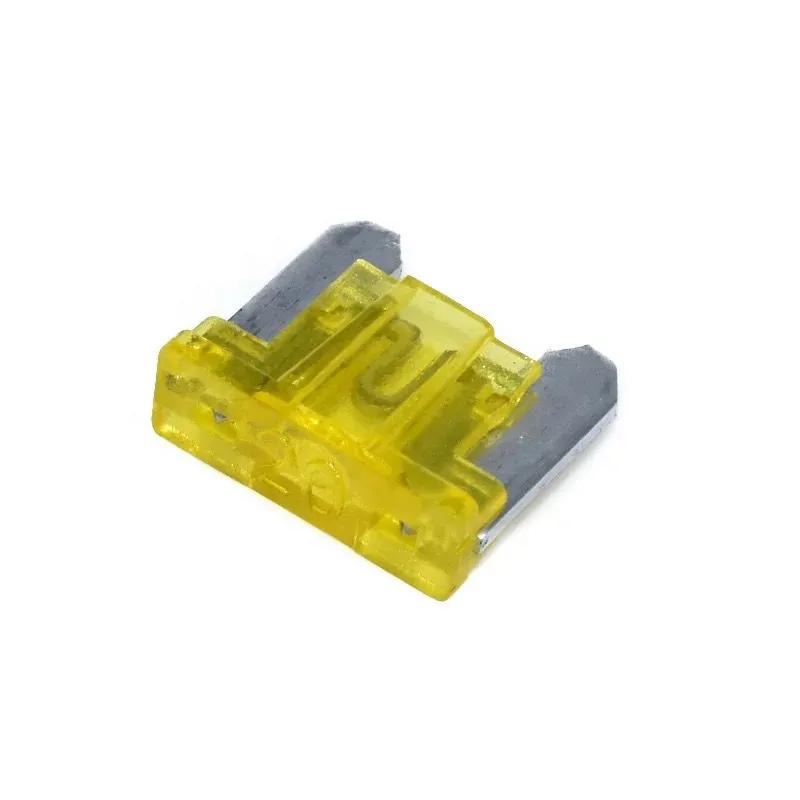
Description
Automotive Fuses – Micro & Standard,Low Profile Mini Blade Fuse
1. Introduction
Auto Fuse is a device designed to interrupt the electrical circuit when subjected to overcurrents. This car fuse’s action is nonreversible and the fuse is intended to be replaced after the circuit malfunction has been corrected.
2. Technical Specifications
| Property | Value |
|---|---|
| Body Material | PC, Polycarbonate |
| Metal Material | Zinc Alloy |
| Interrupting | 1000A @ 32 VDC |
| Voltage Rating | 32V58VDC |
| Ambient Temp | -45°C ~ +85°C |

3. Time-Current Characteristics
| % Of Ampere Rating | Opening Time |
|---|---|
| 100% | 100 hours Min |
| 135% | 0.75 sec Min; 1800 sec Max |
| 200% | 0.15 sec Min; 5 sec Max |
| 350% | 0.08 sec Min; 0.25 sec Max |
| 600% | 0.03 sec Min; 0.1 sec Max |
4. Product Lineup
| Ampere Rating (A) | Part Number | Housing Colors | Resistance Value | Voltage Drop |
|---|---|---|---|---|
| 2A | 2A | 0000 | 46.6 mΩ | 126mV |
| 3A | 3A | 0000 | 33.7 mΩ | 137mV |
| 4A | 4A | 0000 | 20.6 mΩ | 109mV |
| 5A | 5A | 0000 | 16.5 mΩ | 115mV |
| 7.5A | 7.5A | 0000 | 10.2 mΩ | 105mV |
| 10A | 10A | 0000 | 7.38 mΩ | 104mV |
| 15A | 15A | 0000 | 4.55 mΩ | 97mV |
| 20A | 20A | 0000 | 3.25 mΩ | 94mV |
| 25A | 25A | 0000 | 2.50 mΩ | 93mV |
| 30A | 30A | 0000 | 1.94 mΩ | 88mV |
Automotive Fuses – Micro, Standard & Low Profile Mini Blade Fuses | 32V 58V DC
1. Product Overview & Core Classification
Automotive blade fuses are the most common circuit protection components for 12V/24V/48V automotive electrical systems, available in micro, standard (ATO/ATC) and low-profile mini three mainstream sizes. EssFuse’s automotive blade fuses support 32V DC (traditional vehicles) and 58V DC (new energy EV/HEV) dual voltage ratings, with fast-acting characteristics to protect automotive circuits from overcurrent and short circuits.
2. Key Technical Specifications(2026 SAE/ISO 8820 Compliant)
Common Parameters
- Types: Micro blade, Standard (ATO/ATC), Low-profile mini blade
- Rated Voltage: 32V DC (max 40V DC transient), 58V DC (max 65V DC transient)
- Rated Current: 1A, 2A, 3A, 5A, 7.5A, 10A, 15A, 20A, 25A, 30A, 40A
- Breaking Capacity: 1kA (32V DC), 2kA (58V DC)
- Response Time: Fast-acting (blow within 0.1–5s at 10×In)
- Material: Zinc-plated copper element + heat-resistant PA66 housing
- Certifications: SAE J2077, ISO 8820, RoHS compliant
Size Comparison(Key Dimensions)
- Micro Blade: 10.9×3.6×8.5mm (smallest, for tight spaces)
- Standard (ATO/ATC): 19.1×5.1×18.5mm (universal, most common)
- Low-Profile Mini: 15.6×5.1×11.1mm (compact, mini size with low height)
3. Core Working Principle
Automotive blade fuses adopt a zinc-plated copper fuse element inside a plastic housing. When the circuit is overloaded (1.25–4×In) or short-circuited (6–10×In), the fuse element generates heat and melts due to excessive current, breaking the circuit to protect automotive wiring harnesses, ECUs, lights, and electrical accessories from burnout.
- 32V DC Model: For traditional fuel vehicles (12V/24V systems), overload protection at 1.25×In (≤1h), short-circuit protection at 6×In (≤5s)
- 58V DC Model: For new energy EV/HEV (48V mild hybrid systems), enhanced arc extinguishing, withstand 65V DC transient voltage
4. Application Scenarios
- Micro Blade Fuses: Car interior electronics, sensors, small lights, motorcycle circuits
- Standard (ATO/ATC) Fuses: Main circuits, headlights, taillights, starters, fuel pumps
- Low-Profile Mini Fuses: Modern cars, EVs, compact fuse boxes, dashboard electronics
- 58V DC Fuses: 48V mild hybrid systems, EV auxiliary circuits, new energy commercial vehicles
5. Technical Advantages & Compliance
- Three Full Sizes: Micro/standard/low-profile mini, covers all mainstream automotive applications
- Dual Voltage Design: 32V DC (fuel cars) & 58V DC (EVs), compatible with traditional and new energy vehicles
- Fast-Acting Protection: Melts quickly under overload/short circuit, minimizes circuit damage
- High Compatibility: ATC/ATO standard, fits most automotive fuse holders and boxes
- SAE/ISO Certified: Meets global automotive standards, supports international aftermarket sales
6. Installation & Selection Notes
- Installation: Insert into corresponding blade fuse holders, ensure tight contact to avoid virtual connection
- Current Selection: Match circuit rated current (e.g., 10A for 120W 12V lights)
- Voltage Selection: 32V DC for 12V/24V fuel cars; 58V DC for 48V EV/HEV